
Capture what the scout saw.
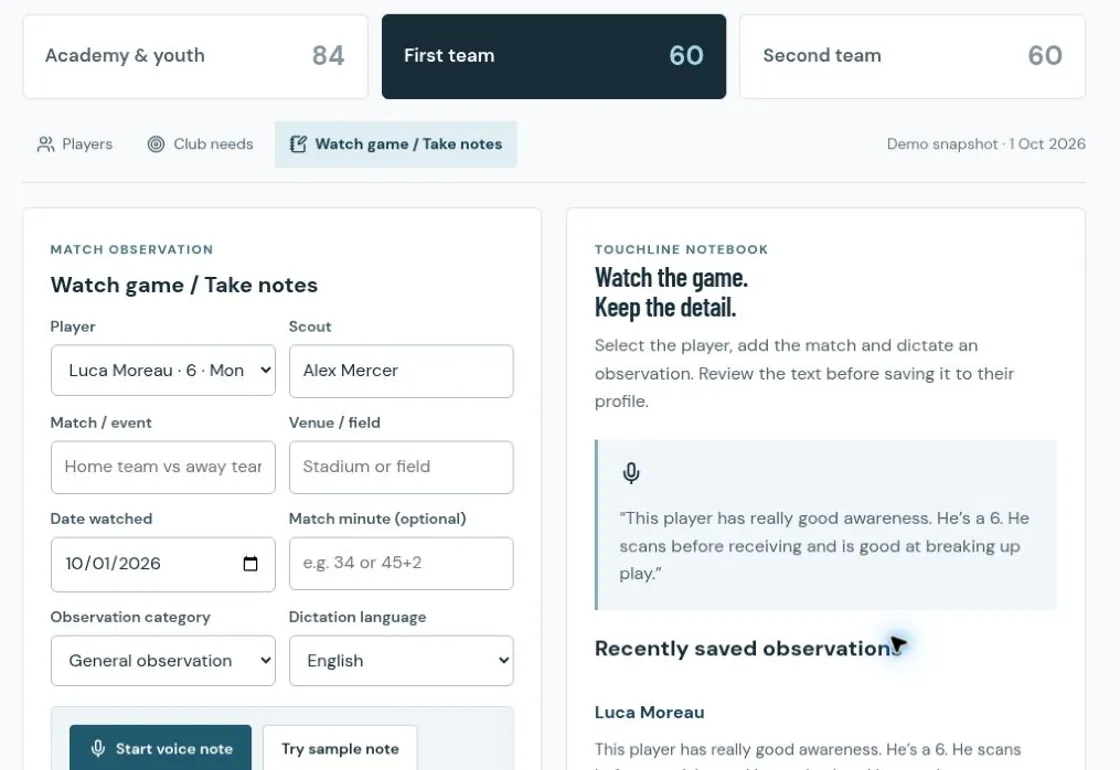
The public scouting example records the player, scout, date, match or event, venue, optional minute and observed position. An observation includes written detail and a rating from 1 to 4 in half steps. Saved entries remain connected to the player profile.
The notebook also offers browser-supported dictation, with text reviewed before saving. It does not replace the scout’s judgment. The important design question is which context your team needs when it returns to an observation weeks or months later.
Organize candidates around actual needs.
The example separates academy and youth, first-team and second-team scouting. Staff can filter the sample player pool and organize club-need categories by position and priority. Academy needs can also use birth years to keep the relevant candidates together.
A shadow depth chart lets the user assign and order recruitment targets for positional roles. That order is set by the user. It demonstrates a way to discuss alternatives and coverage, without claiming an algorithm has identified the right player.
Make the criteria visible beside the evidence.
Positional reference pages in the example describe role expectations and evidence to collect. Player profiles bring together recorded details, observation history and sample physical and soccer figures. Staff can use filters and ordered shortlists to review candidates in a consistent context.
A commissioned scouting platform would begin with your own roles, observation process and decision points. Imported data, additional comparison views, permissions or other connections would need explicit scope and verification. The public demonstration does not connect to a live professional player database.
See the workflow in software
Scouting & Recruitment: public interactive example
Try player filters, club-need categories, dated observations and manually ordered recruitment targets. The committed demonstration uses fictional people, notes and figures.
Organizing positional recruitment needs
See how sample needs and candidate groups can give a recruitment conversation a shared reference. This is an interactive example, not a private client case study.

Questions about your project
Does the example include real scouting intelligence?
No. Players, observations and figures are fictional. Private scouting environments and confidential academy information are not used as public proof or linked from this page.
Does the software find players automatically?
The public example organizes entered information and sample candidates. It does not demonstrate automated player discovery or a live data-provider connection. Those would be separate requirements to assess.
Can a project follow our own recruitment stages?
Yes, the starting conversation should cover how a player moves from an observation to a decision. We agree the records, actions and access needed for that process before defining the build.
Related soccer workflows
Show us how you work.
What is one part of your current workflow that you wish worked differently?
Show Us How Your Club Works